

Compare Grasshopper optimization tools
How SilverHawk compares to Galapagos, Opossum, Wallacei X, Tunny, SilverEye and Octopus across benchmark problems under constrained evaluation and wall-clock budgets.
| Tool | Algorithms | Objectives | Rhino | SilverHawk vs this tool (Report 2026) |
|---|---|---|---|---|
| Galapagos | Genetic algorithm, simulated annealing | Single | Bundled (tested in Rhino 8 SR35) | Shell 0.70 vs 2.79 cm (15 min); 20-city TSP gap 12–15 % vs 51 %; last on 3 of 5 synthetic functions |
| Opossum | RBFOpt, CMA-ES, TPE, MADS; RBFMOpt, NSGA-II, MOEA/D, MACO, NSPSO | Single and multi | Tested 3.1.2 / 3.2.1 | Shell 0.70 vs 1.34 (CMA-ES), 1.45 (TPE), 1.90 (RBFOpt) cm; 20-city TSP gap 12–15 % vs 30–35 %; building MO: HV ≈ +6 % vs its NSGA-II. See scope for low budgets |
| Wallacei X | NSGA-II | Multi | Listed Rhino 6–7 (tested v2.7) | Building MO: HV ≈ +6 % for OSPREY/EAGLE vs its NSGA-II |
| Tunny | Optuna samplers (tested TPE) | Single and multi | Rhino 7–8 | 20-city TSP gap 12–15 % vs 51 % (3 runs, descriptive) |
| SilverEye | Particle swarm | Single | Rhino 5 only (latest available) | 20-city TSP gap 12–15 % vs 38 % |
| Octopus | SPEA-2, HypE | Multi | Rhino 6 (v0.4) | Not tested in the 2026 Report |
| SilverHawk 0.6.36 | 11 single- and 9 multi-objective solvers + selector | Single and multi | Rhino 8, 9 | – |
Measured benchmark results from the 2026 Report
All performance numbers below are taken directly from the SilverHawk Benchmark Report v1.0 (technical report LA-SH-TR-2026-01, deposited openly on Zenodo). Every trial was conducted under controlled experimental conditions on a single dedicated workstation, with external optimizers evaluated at their default settings.
Head-to-head performance inside Grasshopper
Across all benchmark problems executed directly on the Grasshopper canvas (the travelling-salesman instances at 10, 15 and 20 cities, and the 85-variable Kakamigahara shell), CMA-ES from SilverHawk won 15 of the 20 pairwise comparisons against external tools, MERLIN won 13, and none were lost (two-sided Mann-Whitney test, uncorrected pairwise comparisons, α = 0.05).
Kakamigahara free-form shell (D = 85, Karamba3D, 15 minutes)
Starting from a completely flat surface with a maximum deflection of 85.4 cm, solvers optimized 85 vertical control net coordinates under Karamba3D finite-element analysis. All 5 runs of MERLIN or CMA-ES beat all 5 runs of each external tool; median maximum deflection reached 0.70 cm versus 1.34 cm for the best external tool and 2.79 cm for Galapagos GA.
| Solver | Median (cm) | Note |
|---|---|---|
| MERLIN (SilverHawk) | 0.696 | Best run 0.50 cm |
| CMA-ES (SilverHawk) | 0.697 | – |
| L-SHADE-RSP (SilverHawk) | 0.775 | – |
| STRIKE-AS (SilverHawk) | 0.829 | – |
| L-SHADE (SilverHawk) | 0.892 | – |
| Opossum-CMA-ES | 1.340 | p vs MERLIN = 0.008, significant after Holm correction |
| Opossum-TPE | 1.454 | Descriptive p |
| Opossum-RBFOpt | 1.899 | 418 evaluations in 15 min; significant after Holm correction |
| Opossum-MADS | 2.352 | Descriptive p |
| Galapagos GA | 2.790 | p = 0.012, significant after Holm correction |
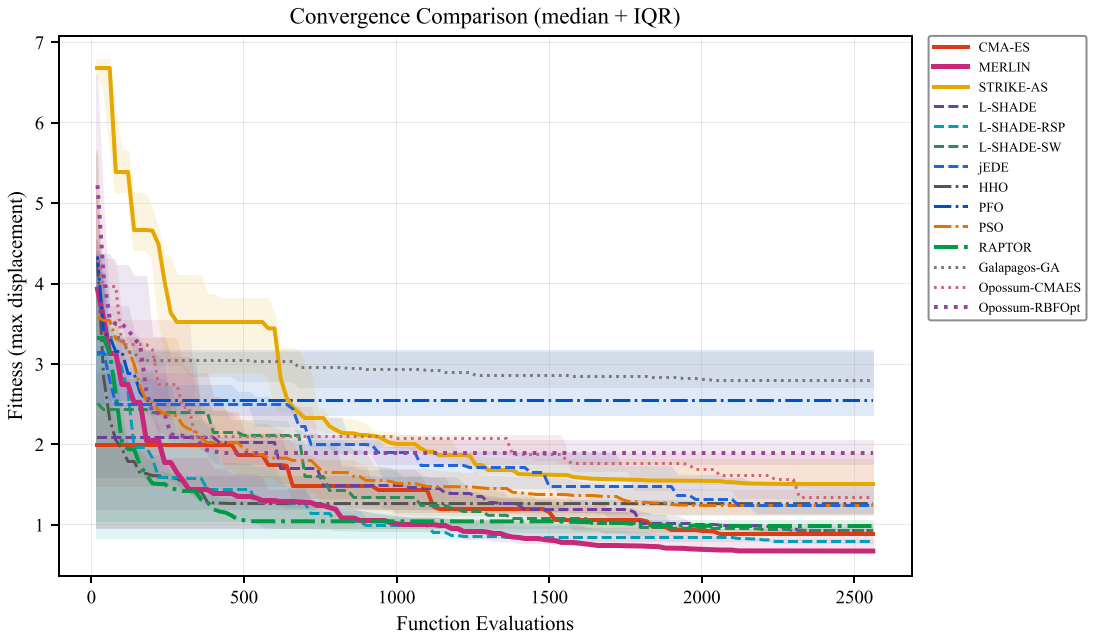
Historical context: In Cichocka et al. (2017), using a different variable domain [−10, 10] m versus our [−5, 5] m and another FE engine, reported 15-minute deflections were: SilverEye 1.79 cm, Octopus 4.25 cm, and Galapagos 4.74–5.36 cm.
Travelling Salesman Problem (TSP) in Grasshopper (1,200 evaluations)
Tested across 10 independent runs (3 for Tunny due to run duration). Exact Held-Karp mathematical optima are 39.06 (10 cities), 44.78 (15 cities), and 48.46 (20 cities). At 10 cities all solvers except HHO were statistically indistinguishable. At 20 cities no solver reached the theoretical optimum; the best single tour found was 49.32 (MERLIN).
| Solver | 15 cities (Optimum: 44.78) | 20 cities (Optimum: 48.46) |
|---|---|---|
| CMA-ES (SilverHawk) | 44.78 (0.0 %) | 54.29 (12.0 %) |
| MERLIN (SilverHawk) | 50.62 (13.1 %) | 55.63 (14.8 %) |
| Opossum-RBFOpt | 46.64 (4.1 %) | 63.00 (30.0 %) |
| Opossum-CMA-ES | 56.50 (26.2 %) | 65.22 (34.6 %) |
| SilverEye | 55.97 (25.0 %) | 66.98 (38.2 %) |
| Galapagos GA (generation 60 = 1,200 FE) | 64.36 (43.7 %) | 73.12 (50.9 %) |
| Tunny TPE (n = 3) | 75.88 (69.5 %) | 73.00 (50.6 %) |
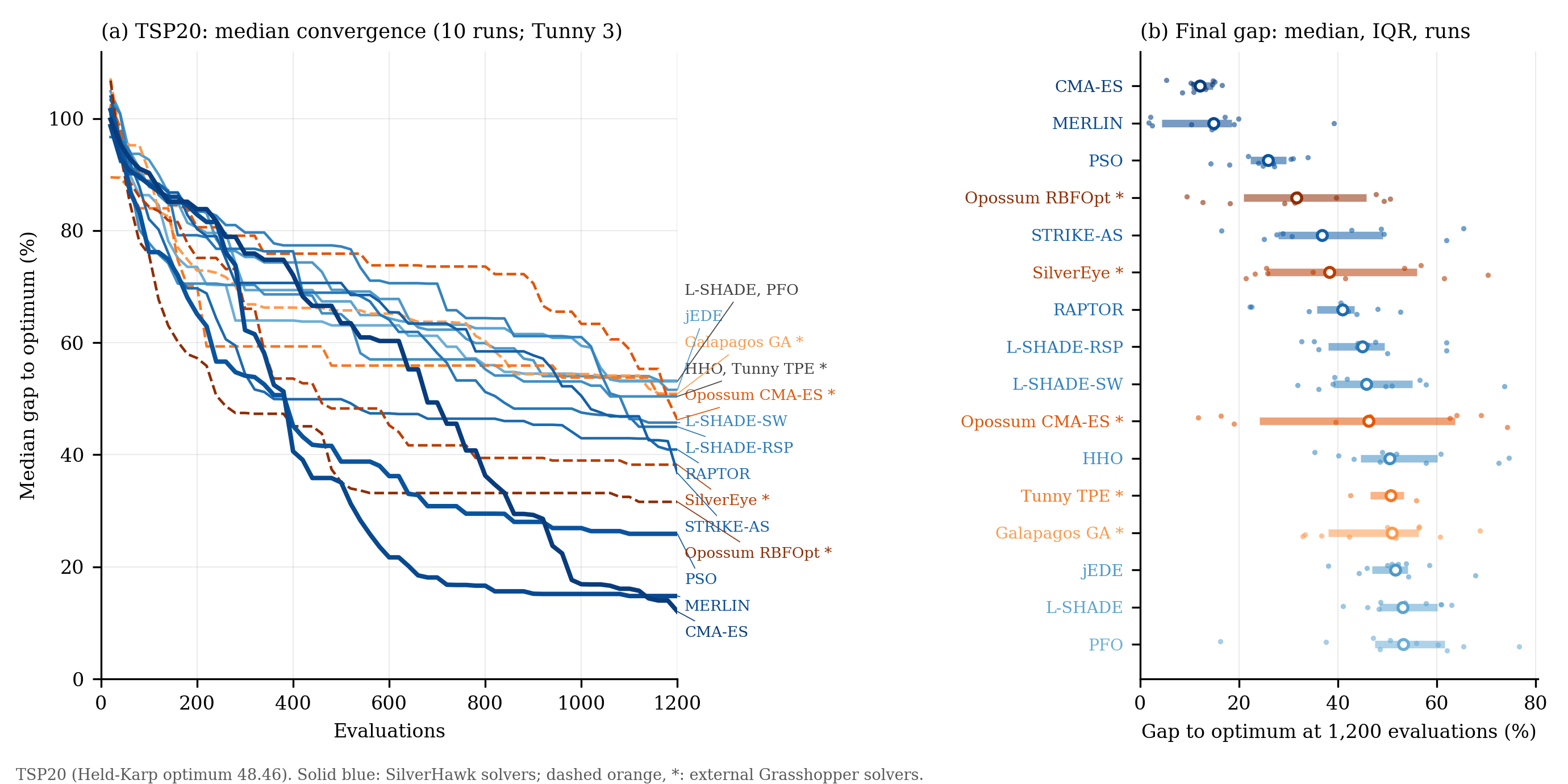
Notes: Opossum-RBFOpt was the only competitive external tool, with no statistically significant difference from CMA-ES, though its runs took 3–25 minutes compared to approximately 1 minute for population solvers. The Galapagos value represents generation 60 (1,200 FE).
Canvas test functions (D = 10, 1,200 evaluations)
- Galapagos finished last on 3 of 5 functions and penultimate on a fourth; on Sphere and Rosenbrock its median was four orders of magnitude above the leader.
- At equal evaluations, Opossum-RBFOpt maintained the best median on shifted Rastrigin (11.9 vs 20.3 for MERLIN) and shifted Rosenbrock (6.66 vs 8.56 for CMA-ES); its runs took 162–1,006 s versus 40–57 s for most SilverHawk solvers.
- Functions with optima at the origin favor HHO (mean rank 1.6 at D = 30, which drops to 11.0 after shift and rotation): for this reason, comparisons with external tools use shifted and rotated functions.
Building multi-objective optimization (Zorn emulator, 22 variables, 3 objectives, 5,000 FE)
Evaluated on the shoebox office benchmark by Zorn et al. (2025) optimizing total energy Q_tot, overheating hours K_h, and daylight factor DF using a GBR-ANN emulator (RMSE on energy 2.84 kWh/(m²·a)). OSPREY and EAGLE exceeded the hypervolume of the NSGA-II of Wallacei X and Opossum by approximately 6 %, and MOEA/D, MACO, and NSPSO of Opossum by approximately 20 % (5 runs per tool).
| Configuration | HV | Mean gap |
|---|---|---|
| OSPREY (SilverHawk) | 41.99 | −0.41 % (reference) |
| EAGLE (SilverHawk) | 41.53 | −0.59 % |
| GDE3 / STRIKE-MO / TALON (SilverHawk) | 41.68 / 41.45 / 41.16 | −1.0 … −1.8 % |
| NSGA-II (Wallacei X 2.7) | 39.43 | −5.78 % |
| NSGA-II (Opossum) | 39.25 | −6.52 % |
| MOEA/D (Opossum) | 34.12 | −18.97 % |
| MACO (Opossum) | 33.51 | −19.07 % |
| NSPSO (Opossum) | 33.01 | −21.78 % |
| RBFMOpt (Opossum), 500 FE | 37.97 | −8.98 % (budget capped at 500 FE; see note below on surrogate scaling) |
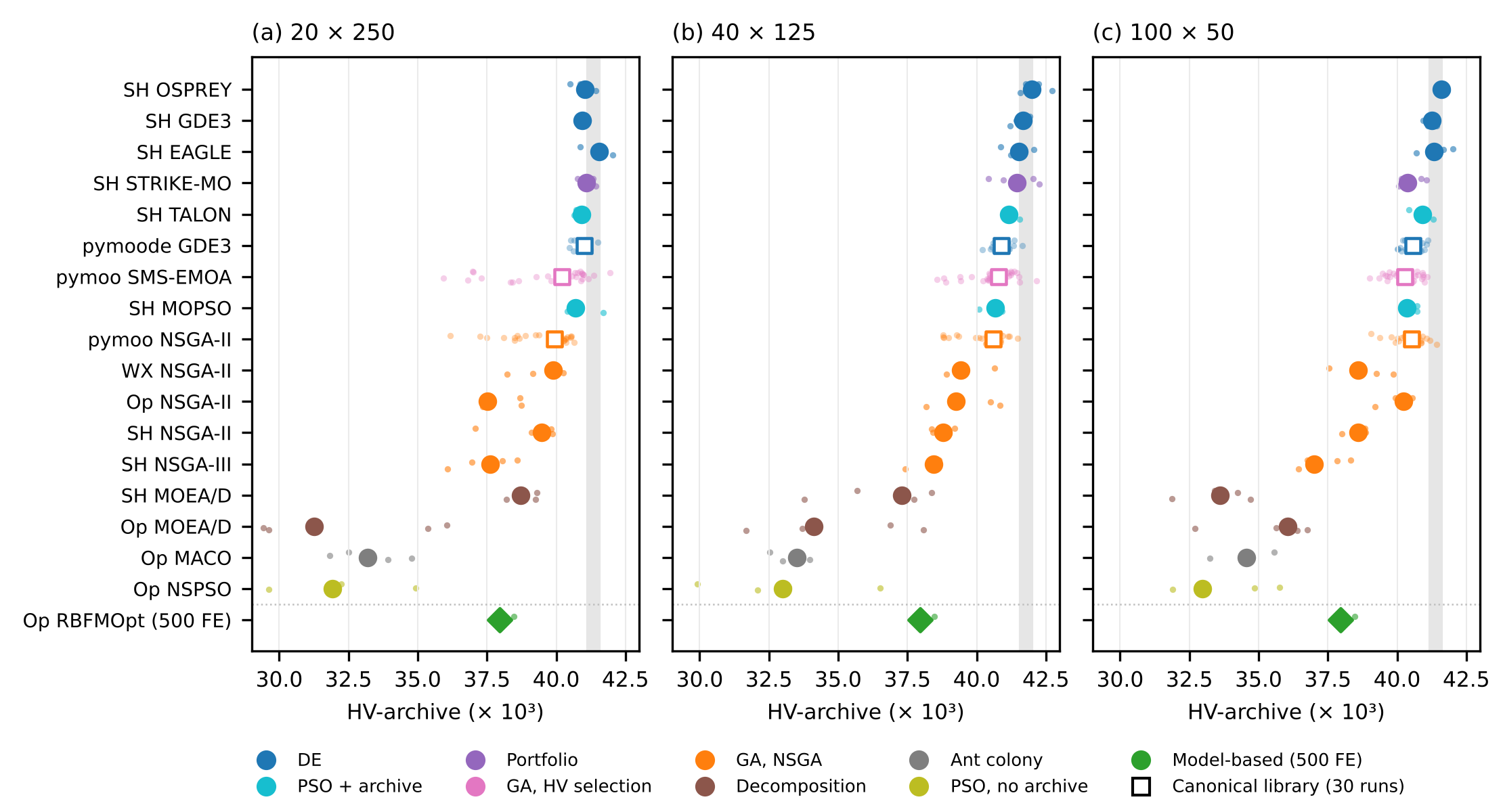
Note on RBFMOpt budget and surrogate computational scaling: RBFMOpt was evaluated at 500 evaluations, following the budget recommended in the simulation-based architectural design optimization literature (Wortmann 2017, 2019; Zorn et al. 2025). As documented in the Benchmark Report (§9.4), surrogate-based methods (radial basis functions with auxiliary mixed-integer optimization) exhibit non-linear computational complexity per iteration: while internal solver overhead was ~0.4 s/FE at 500 evaluations (totaling 2.7 minutes on canvas), extending the run towards 2,000 evaluations caused the per-evaluation overhead to scale to 9.4 s/FE, resulting in a single run exceeding 2 hours 16 minutes.
Practical engineering implication: Surrogate-assisted algorithms are the benchmark reference for strictly small budgets (≤ 500 evaluations) when each physical simulation takes multiple minutes, rendering internal mathematical overhead negligible. Conversely, when parametric evaluations take seconds or fractions of a second, population-based metaheuristics (such as SilverHawk's DE and CMA-ES variants, whose canvas overhead is ~50 ms) scale smoothly to thousands of evaluations, achieving superior Pareto hypervolume in a fraction of the wall-clock time (for instance, the median OSPREY run surpassed after 1 minute the final hypervolume of a 136-minute RBFMOpt run; Report §9.4, Fig. 7b).
Design and statistical caveats: (i) Within the error of the emulator (RMSE 2.84 kWh/(m²·a)), 14 configurations reached the target energy demand to within 2 kWh/(m²·a), indicating practical design convergence despite numerical hypervolume differences. (ii) P-values between OSPREY/EAGLE and Wallacei X were not formally computed in the Report; statistical significance is not asserted.
Multi-objective shell bridge application
On the multi-objective shell bridge problem evaluated in Karamba3D (15 minutes, 5 runs per tool): at equal time, SilverHawk solvers are on par with or above Opossum RBFMOpt in hypervolume.
Methodological transparency and algorithm implementation
- The algorithm name does not identify the method: Four implementations of NSGA-II (SilverHawk, Opossum, Wallacei X, and the pymoo library) differed by up to 6.4 % in hypervolume on the same problem under identical allocations.
- Test rankings do not transfer directly to design: Rankings on standard ZDT test functions do not predict performance on the building problem (OSPREY and EAGLE, which led on the building problem, ranked 8th and 10th on average on ZDT; Spearman correlation 0.76).
- Open self-correction: The Benchmark Report openly documents and corrects earlier evaluation accounting (such as reading Galapagos at 1,200 evaluations rather than entire runs), ensuring trustworthy replication.
How we compared
Common experimental protocol
- Dedicated workstation: Intel Core i7-4770K (3.5 GHz, 4 cores), 32 GB RAM, Windows 10; Rhinoceros 8 SR35; Karamba3D 3.1.60921.0 for structural shell analyses.
- External tools tested at default settings: Galapagos (Rhino 8 SR35 build), Opossum 3.1.2 (RBFOpt, CMA-ES, building MO) and 3.2.1 (RBFMOpt, TPE, MADS), SilverEye (latest available release, tested in Rhino 5 where it runs), Tunny 1.3.2 (TPE), Wallacei X 2.7.
- Controlled budgets: 1,200 evaluations (60 generations × 20) for single-objective problems with fast models; 15 minutes fixed wall-clock time for shell finite-element runs; 5,000 evaluations for the building multi-objective problem.
- Replication sample: 10 runs for TSP and synthetic problems (3 for Tunny due to multi-hour run durations); 5 runs for shell and building multi-objective benchmarks.
- Statistical testing: Two-sided Mann-Whitney test (α = 0.05); Holm correction applied where one solver is tested against all competitors; pairwise head-to-head comparisons are uncorrected.
Scope of these results
Scope of these results. All results come from one workstation with the competing tools at their defaults, 5 runs on shells and multi-objective problems (3 for Tunny) and 10 on travelling-salesman and synthetic problems; differences between neighbouring solvers are often not significant. The budgets are about 1,200 evaluations or 15 minutes. For slow models (seconds to minutes per evaluation) and strictly constrained budgets of a few hundred evaluations (≤ 500 FE, the recommended regime in Wortmann 2017, 2019 and Zorn et al. 2025), a surrogate-based solver such as Opossum RBFOpt/RBFMOpt is the reference: at 418 evaluations on the shell, MERLIN and RAPTOR are not significantly different from RBFOpt; on the multi-objective building problem at 500 evaluations RBFMOpt leads every population-based configuration. Because surrogate modeling overhead scales non-linearly with sample size (from 0.4 s to 9.4 s per evaluation in RBFMOpt; Report §9.4), extending surrogate runs to thousands of evaluations causes severe runtime degradation, giving population-based metaheuristics an overwhelming speed and exploratory advantage on fast or moderate models. SilverHawk 0.6.36 includes no surrogate-based solver; one is on the roadmap. The building problem is solved on an emulator; the travelling-salesman instances are test problems.
Frequently asked questions
What is the best alternative to Galapagos in Grasshopper?
Opossum, Wallacei X, Tunny, SilverEye, Octopus and SilverHawk all replace Galapagos for different problems. In the SilverHawk Benchmark Report 2026, on a 85-variable shell, travelling-salesman instances and synthetic functions, Galapagos finished behind the SilverHawk solvers in every campaign.
Which Grasshopper solver is best for structural optimization?
On the Kakamigahara shell (85 variables, Karamba3D, 15 minutes), MERLIN and CMA-ES from SilverHawk reached a median maximum displacement of 0.70 cm, against 1.34 cm for the best external tool and 2.79 cm for Galapagos.
Is SilverHawk better than Opossum?
In the 2026 tests with budgets of about 1,200 evaluations or 15 minutes, SilverHawk solvers were ahead on the shell and the travelling-salesman instances. For slow models and a few hundred evaluations, Opossum RBFOpt is the reference, and a surrogate-based solver is on the SilverHawk roadmap.
Wallacei X or SilverHawk for multi-objective optimization?
On a three-objective building problem, the OSPREY and EAGLE configurations of SilverHawk reached a hypervolume about 6 % above the NSGA-II of Wallacei X (5 runs each); differences are smaller than the error of the surrogate model in design terms.
Does the same algorithm give the same result in different tools?
No. Four NSGA-II implementations differed by up to 6.4 % in hypervolume on the same problem, so the algorithm name alone does not identify the method.
How reliable are these comparisons?
All runs, settings and limits are public in the SilverHawk Benchmark Report 2026 (Zenodo), with the two preprints on arXiv; competitors ran at default settings on one workstation.
Evidence and references
Benchmark Data & Preprints
- SilverHawk – Benchmark Report v1.0. Zenodo Technical Report LA-SH-TR-2026-01, 136 pp. doi:10.5281/zenodo.23768134 ↗
- Hybrid metaheuristics for architectural design optimization under small evaluation and wall-clock budgets. arXiv:2610.26202 [cs.NE]. arXiv:2610.26202 ↗
- When the implementation matters more than the algorithm: NSGA-II and other multi-objective optimizers in engineering design tools. arXiv:2610.22397 [cs.NE]. arXiv:2610.22397 ↗
- Replication packages & datasets. Zenodo repositories. MO Data (10.5281/zenodo.23157761) ↗ · Tool Data (10.5281/zenodo.23724278) ↗
External Studies & Tools
- Opossum – Introducing and evaluating a model-based optimization tool for Grasshopper. Proc. CAADRIA 2017, 283–292. doi ↗
- Genetic evolution vs. function approximation: Benchmarking algorithms for architectural design optimization. J. Comput. Des. Eng. 6(3), 414–428. doi ↗
- Optimizing an expensive multi-objective building performance problem. Energy & Buildings 336, 115562. doi ↗
- Evaluating multi-objective architectural design optimization. J. Phys.: Conf. Ser. 2042, 012066. doi ↗
- SILVEREYE: The implementation of Particle Swarm Optimization algorithm in a design optimization tool. Proc. 22nd CAADRIA, 151–160.
- RBFOpt: an open-source library for black-box optimization with costly evaluations. Math. Prog. Comp. 10(4), 597–629. doi ↗
- Galapagos: On the Logic and Limitations of Generic Solvers. Architectural Design 83(2), 132–135.