

A free-form shell with 85 variables
The concrete roof of the Meiso no Mori crematorium in Kakamigahara, Japan, designed by Toyo Ito with structural design by Mutsuro Sasaki, has been a structural optimisation benchmark since 2007. This lesson describes the problem and lets you move the control points that define its shape.
Schematic of the parametrisation, not the geometry of the roof: a 10 × 10 control net of a cubic surface, 80 × 60 m, heights drawn ×2.
The problem in numbers
- Structure
- Shell roof of about 80 × 60 m, 20 cm of reinforced concrete, resting on 12 conical columns and 4 cores.
- Surface
- A cubic NURBS surface controlled by a 10 × 10 net: 100 control points.
- Variables
- The heights of 85 control points, each free in [−5, +5] m. The other 15 are fixed by the supports.
- Analysis
- Linear finite elements in Karamba3D. One evaluation takes about 0.4 s on a desktop workstation, so a 15-minute run is a little over two thousand evaluations.
- Objective
- Minimise the maximum displacement of the shell, in cm. A common target is 3 cm, about span/300 for the shortest span between supports (8.8 m).
Almost two decades of the same problem
It is one of the longest-running optimisation problems in computational architecture. Each study changed the tools and some of the settings, so the absolute displacements are not directly comparable across studies; what the line shows is how the same shape kept being asked a harder question.
| Year | Who | Tools | Contribution |
|---|---|---|---|
| 2004 | Sasaki | Sensitivity analysis | Gradient-based improvement of the form of the real building, minimising strain energy. |
| 2007 | Pugnale and Sassone | RhinoScript, Ansys, custom genetic algorithm | First computational morphogenesis of the shell as an optimisation problem. |
| 2013 | Pugnale | Grasshopper, Karamba, Galapagos | The problem reinterpreted in Grasshopper (a blog post), the version used in later studies. |
| 2017 | Cichocka et al. | SILVEREYE particle swarm | Particle swarm compared with Galapagos and Octopus over 30 runs; the best published result is 0.6 cm in an 8-hour run. |
| 2026 | Ambrosini | Grasshopper, Karamba3D, CMA-ES hybrid | A CMA-ES hybrid and plain CMA-ES compared with the optimizers of Galapagos, SilverEye, Opossum and Tunny on the built shell: they end 48 % below the best external tool in 15 minutes (preprint). |
The benchmark setup in Rhino and Grasshopper
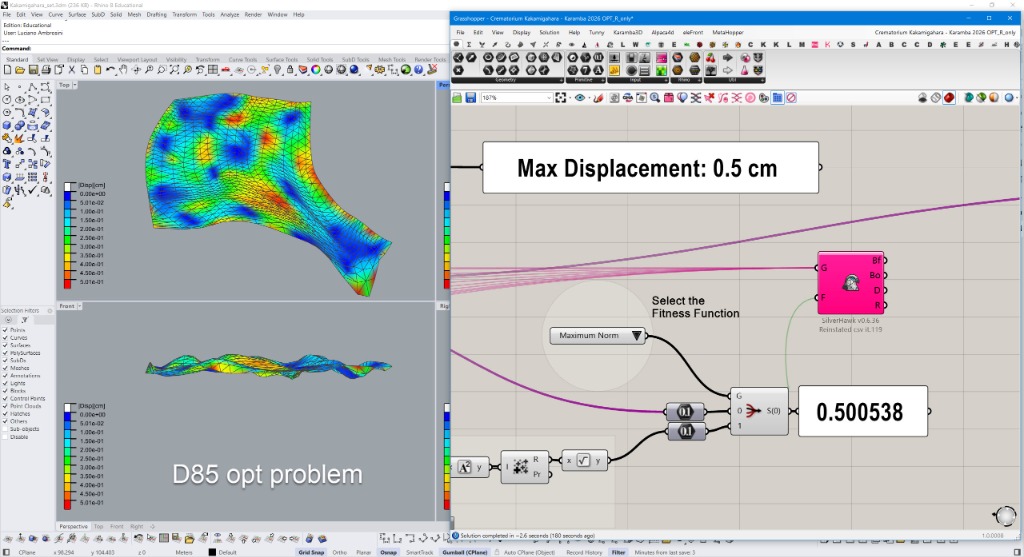
Representative setup for the D85 structural benchmark
Finite-element analysis: In the Rhino 8 viewports (left), top and front views display the Crematorium Kakamigahara free-form roof analyzed in Karamba3D. The displacement contour field illustrates structural deformation across the 85 variable heights (target: max displacement ≤ 0.5 cm).
SilverHawk solver: On the Grasshopper canvas (right), the structural evaluation pipeline feeds directly into the SilverHawk solver component, selecting the fitness function (Maximum Norm) to achieve an optimal displacement of 0.500538 cm.
What it teaches
Eighty-five variables that cannot be tuned one at a time: neighbouring control points shape the same patch of surface, so moving one makes the best value of its neighbours change. That is the curved valley of Rosenbrock in eighty-five dimensions. Press Random genes above: a random vector of heights gives a crumpled shell, and that is what the first population of a run looks like.
The evaluation is expensive enough for time to matter, and the optimum is unknown: the published value of 0.6 cm is a record, not a floor. It is a problem where the budget, not the algorithm’s elegance, decides what can be tried. How the SilverHawk solvers behave on it is reported in the studies listed on the Research page.
References
Structural Benchmark & Morphogenesis
- Morphogenesis and structural optimization of shell structures with the aid of a genetic algorithm. Journal of the International Association for Shell and Spatial Structures, 48(3), 161–166. IASS
- Morphogenesis of Flux Structure. Architectural Design, 77(1), 94–101. doi ↗
Optimization Algorithms & Benchmarking
Continue exploring
The landscapes
Classic test functions as 3D surfaces with a search running on them, the multi-objective ZDT set, and why design problems are different.
Open lesson →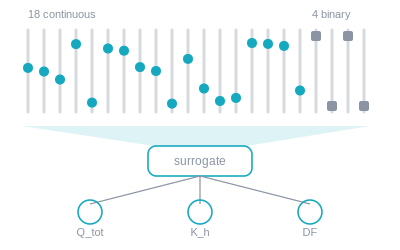
A building with 22 variables
A daylight and energy problem with three objectives, made repeatable with surrogate models.
Open lesson →The Travelling Salesman on canvas
Discrete ordering in Grasshopper: the DataTree branch bias of the SilverEye tutorial, and how a normalized permutation encoding reveals true solver capability.
Open lesson →Two ways to spend a budget
How population-based metaheuristics and surrogate models spend evaluation budgets differently, and why SilverHawk is developing a native RBF solver.
Read deep dive →