Full Algorithm Registry
SilverHawk exposes a curated portfolio of single-objective and multi-objective algorithms behind one unified interface.
Algorithms marked SilverHawk were developed specifically within the project; the others are established methods implemented from academic literature, in some cases with documented modifications (marked "SH"). In the solver drop-down, a star (★) indicates algorithms recommended for the detected problem type.
Choosing an Algorithm
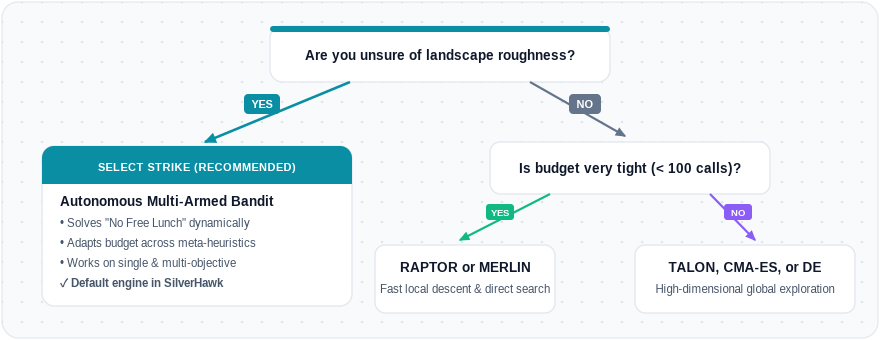
No optimization algorithm outperforms all others on every problem landscape. For a new problem with an unknown landscape, STRIKE (for single-objective) or STRIKE-MO (for multi-objective) is the recommended first choice: it tests candidate algorithms during early iterations and reports which solver performed best, so that subsequent runs can use that algorithm directly.
For computationally expensive architectural models, evaluation budgets are strictly limited; choose population sizes and iteration counts that fit the available time (
Solver Recommender Wizard
Select the characteristics of your Grasshopper optimization problem to see which solver gave the best results in the benchmarks. It is an evidence-based indication, not a guarantee of optimality.
On continuous functions with interacting variables MERLIN is first at D = 10 and D = 30 (mean rank 1.29 and 1.00). With binary choices (the 22-variable building) jEDE won instead. If you do not know the landscape, STRIKE tries the candidates in a warm-up and continues with the best one: it does not guarantee to beat the best solver, and above D = 15 the warm-up costs about 560 FE.
Single-Objective Algorithms
| Algorithm | Family | Provenance & Description |
|---|---|---|
| STRIKE ★ | SilverHawk Hyper-heuristic | Warm-up of candidate algorithms followed by selection of the best; features three modes (AutoSelect, Bandit, Scout). |
| MERLIN ★ | SilverHawk Evolutionary | Evolution-strategy based hybrid designed for rugged landscapes under small budgets. |
| CMA-ES | Evolutionary | Covariance Matrix Adaptation Evolution Strategy (Hansen & Ostermeier, 2001). State-of-the-art continuous covariance adaptation. |
| jEDE | Evolutionary | Self-adaptive differential evolution as implemented in the Optimus plug-in (after Brest et al., 2006). |
| L-SHADE ★ | Evolutionary | Success-history adaptive differential evolution with linear population size reduction (Tanabe & Fukunaga, 2014); zero user hyperparameters required. |
| L-SHADE-RSP | Evolutionary | L-SHADE with rank-based selective pressure (after Stanovov et al., 2018). |
| L-SHADE-SW | SilverHawk Evolutionary | L-SHADE with integrated exploratory local search mechanics. |
| RAPTOR ★ | SilverHawk Swarm | Particle-swarm based hybrid with adaptive parameters, specifically suited to multimodal landscapes. |
| HHO | Swarm | Harris Hawks Optimization (Heidari et al., 2019). Simulates predatory surprise pounces. |
| PFO | Swarm | Peregrine Falcon Optimization, a nature-inspired swarm metaheuristic (Wu & Liu, 2023). |
| PSO | Swarm | Classical particle swarm with inertia weight (Shi & Eberhart, 1998); the historical baseline of earlier swarm tools in architectural design. |
Multi-Objective Algorithms
| Algorithm | Family | Provenance & Description |
|---|---|---|
| STRIKE-MO ★ | SilverHawk Hyper-heuristic | Automatic selection among three SilverHawk MO algorithms, rewarded dynamically by hypervolume progress. |
| EAGLE ★ | SilverHawk Evolutionary / Swarm | Differential-evolution core with swarm and indicator-based selection; handles all Pareto front topologies. |
| OSPREY ★ | SilverHawk Evolutionary hybrid | Pareto dominance ranking with hypervolume-contribution selection. |
| TALON ★ | SilverHawk Swarm | Archive-guided multi-objective swarm; highly effective on concave fronts and architectural benchmarks. |
| NSGA-II (SH) | Evolutionary | Non-dominated sorting genetic algorithm (Deb et al., 2002) with a bounded Simulated Binary Crossover operator ( |
| NSGA-III (SH) | Evolutionary | Reference-point based NSGA for many-objective optimization (Deb & Jain, 2014), same operator setting. |
| MOEA/D | Decomposition | Multi-objective evolutionary algorithm based on decomposition (Zhang & Li, 2007). |
| GDE3 | Evolutionary | Generalized Differential Evolution 3 (Kukkonen & Lampinen, 2005). |
| MOPSO | Swarm | Multi-objective particle swarm optimization (Coello Coello et al., 2004). |
SURROGATE ROADMAP
No surrogate-based solver is included in the current release; a native surrogate solver is in development (see the Roadmap).
::: note "SH" MODIFICATIONS Algorithms flagged "SH" are variants with documented parameter or operator changes optimized for Grasshopper evaluation budgets, and are not guaranteed to reproduce the exact historical results of the original theoretical publications. :::
Multi-Objective Metrics
- Hypervolume (HV): Quantifies the volume of objective space dominated by a front, bounded by a reference point (Zitzler & Thiele, 1999). Larger is better.
- Front Spacing: Measures the uniformity and relative distance between adjacent non-dominated solutions.
- Inverted Generational Distance (IGD): For benchmarks with an analytically known true Pareto front, quantifies convergence and coverage distance.
- Knee Point: The compromise solution on the front with the best trade-off, calculated using the method of Das (1999) on normalized objectives. It is also used to propose recommended single-objective configurations in the exported CSV.
Visual Decision Matrix