
STRIKE: Algorithm Selection
STRIKE is SilverHawk's hyper-heuristic: instead of running one algorithm, it tests a small pool of candidate solvers on your problem and then hands the run to the one that performs best. It is an algorithm selector, and its default mode is explore-then-commit. Only the optional Bandit mode behaves as a true online multi-armed bandit.
Why a selector?
No algorithm is best on every landscape, and in Grasshopper the evaluation budget is small: trying several solvers by hand costs more evaluations than a single run. STRIKE spends a part of the budget on a short comparison and uses the rest on the winner. The report states which standalone solver performed best, so later runs can skip the comparison.
The three modes (STRIKE, single-objective)
| Mode | What it does | Use it when |
|---|---|---|
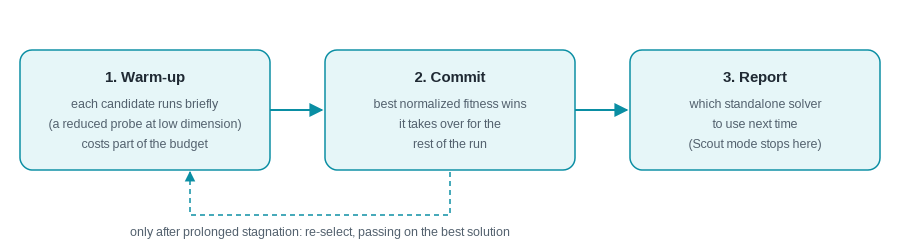
| AutoSelect (default) | Warm-up: candidates run briefly. Commit: the candidate with the best normalized fitness takes over for the rest of the run. If the committed solver stagnates for a long time, the selection is repeated and the best solution found so far is passed to the new solver. At the end the report names the standalone solver to use next time. | You want a good result on an unknown problem in a single run. |
| Bandit | The choice among candidates is revised continuously during the run, with bandit-style credit assignment (online selection). It is the only mode that works as a multi-armed bandit. | You expect the best solver to change during the run. It is not the default and was not the configuration used in the benchmark campaign. |
| Scout | Diagnostic mode: compares the candidates with settings adapted to the problem dimension and recommends which solvers to use or try. It reports and stops. | You want a recommendation before investing in long runs. |
Candidate pool. The single-objective pool is made of the strongest solvers of the portfolio (currently MERLIN, RAPTOR, L-SHADE-RSP and HHO). At low dimension (D ≤ 15) STRIKE saves budget with a reduced probe: MERLIN plus a second candidate chosen from an analysis of the problem landscape; at higher dimension all candidates are probed.
Budget. The warm-up consumes evaluations. With Fixed FE budget (fair benchmark) it is counted inside the declared budget, so a STRIKE run and a standalone run use the same number of evaluations (see Solver Panel).
STRIKE-MO
STRIKE-MO works the same way for multi-objective problems, but in a simpler form: each of its three candidates (OSPREY, EAGLE, TALON) is run independently for a short probe, the hypervolume reached by each is compared, and the run continues only with the best one. There is no transfer of fronts between candidates and no online bandit.
What to expect
STRIKE's value is not to beat the best single solver but to spare you from knowing it in advance. It pays for this with the warm-up, and it can lose to a solver that happens to suit the problem: in the TSP-20 campaign, STRIKE-AS (an earlier build) ranked 7th of 16 configurations, behind CMA-ES and MERLIN (see TSP). If you already know which solver fits, use it directly; if you do not, STRIKE (or Scout, for a recommendation only) is a reasonable first step. See also the Algorithm Registry.