
Cross-Comparison & Benchmark Report 2026
This section synthesizes the empirical evidence, cross-solver rankings, and core scientific findings documented in the SilverHawk Benchmark Report 2026 (v1.0) (Zenodo Technical Report LA-SH-TR-2026-01, doi:10.5281/zenodo.23768134) and accompanying preprints (arXiv:2610.26202 and arXiv:2610.22397).
Methodology and solvers
The single-objective campaign compares 16 configurations: 11 SilverHawk solvers and 5 external ones (Galapagos, Opossum-RBFOpt, Opossum-CMA-ES, SilverEye, Tunny-TPE). Wallacei X is added for the multi-objective building and ZDT problems. Default budget 1,200 evaluations; 30 runs on console functions, 10 on canvas synthetic and TSP problems (3 for Tunny), 5 on the shell.
| Category | Optimization Solvers Evaluated | Search Characteristics |
|---|---|---|
| SilverHawk | STRIKE (STRIKE-AS in the tables), MERLIN, CMA-ES, L-SHADE, L-SHADE-RSP, L-SHADE-SW, RAPTOR, jEDE, PSO, HHO, PFO (multi-objective solvers are covered below) | Compiled in C# (.NET 8), no Python bridge. Solvers ran in the plug-in builds current at each campaign (0.5.x–0.6.32), not necessarily the latest release. |
| Galapagos GA (Rutten, 2010) | Standard Genetic Algorithm with elitism | Visual programming baseline; historical standard in Grasshopper. |
| SilverEye (Cichocka et al., 2017) | Particle Swarm Optimization (PSO) | Canonical swarm tool widely cited in architectural literature. |
| Opossum (Wortmann, 2017) | Opossum-RBFOpt (RBF Surrogate) & Opossum-CMAES | Model-based surrogate optimization relying on an external Python bridge. |
| Tunny (Nakamura, 2021) | Tree-structured Parzen Estimator (TPE via Optuna) | Bayesian / hyperparameter optimization requiring background subprocesses. |
Finding 1: time-fair rank inversion
Ranking solvers per function evaluation and per unit of wall-clock time can give very different orders (time-fair rank inversion):
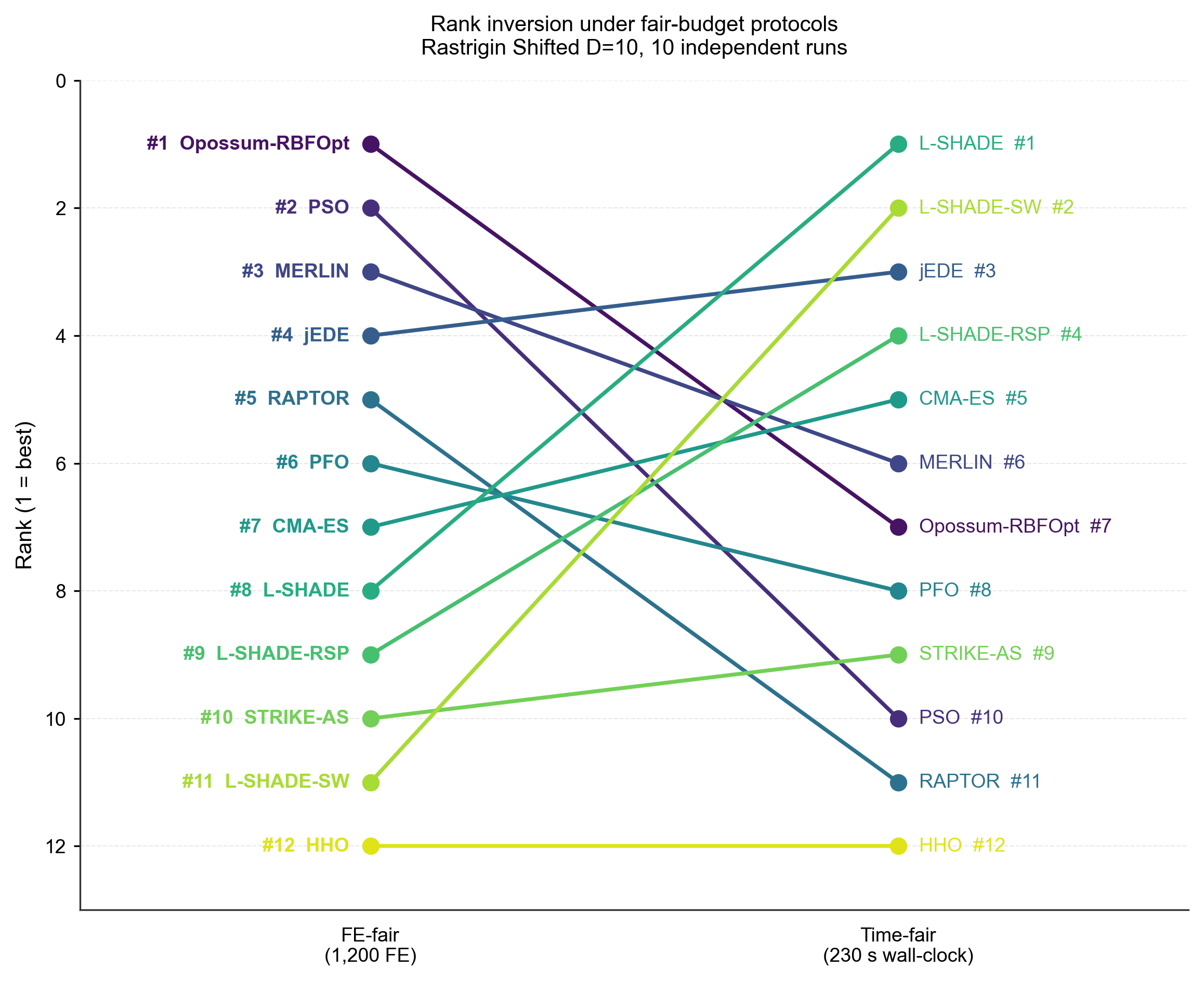
Why rank inversion occurs
- Surrogate overhead. Opossum-RBFOpt spends about 1.75 s per evaluation on model fitting (0.4 s of analysis on the shell), reaching 418 evaluations in 15 minutes. A TSP run takes 3–25 min versus about 1 min for population solvers.
- Population solvers have negligible overhead (about 50 ms per evaluation in the building problem).
- The crossover. Per evaluation the surrogate is as efficient as the best metaheuristics. If one evaluation takes minutes (slow daylight or CFD models), the balance reverses and the surrogate is the right choice. The conclusion is a rule of thumb about cost per evaluation, not a ranking of tools.
Finding 2: single-objective regimes
Across the synthetic test functions at
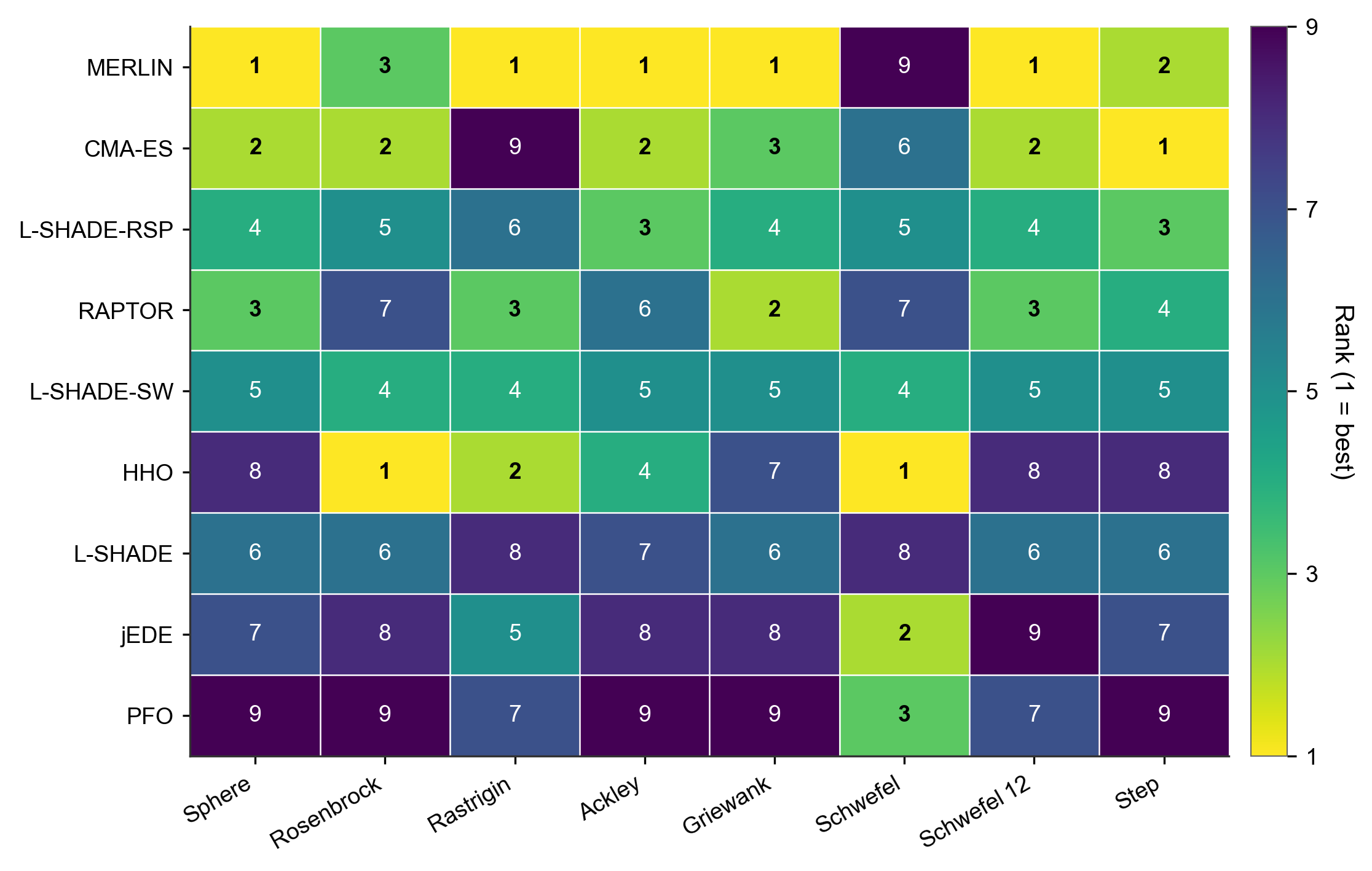
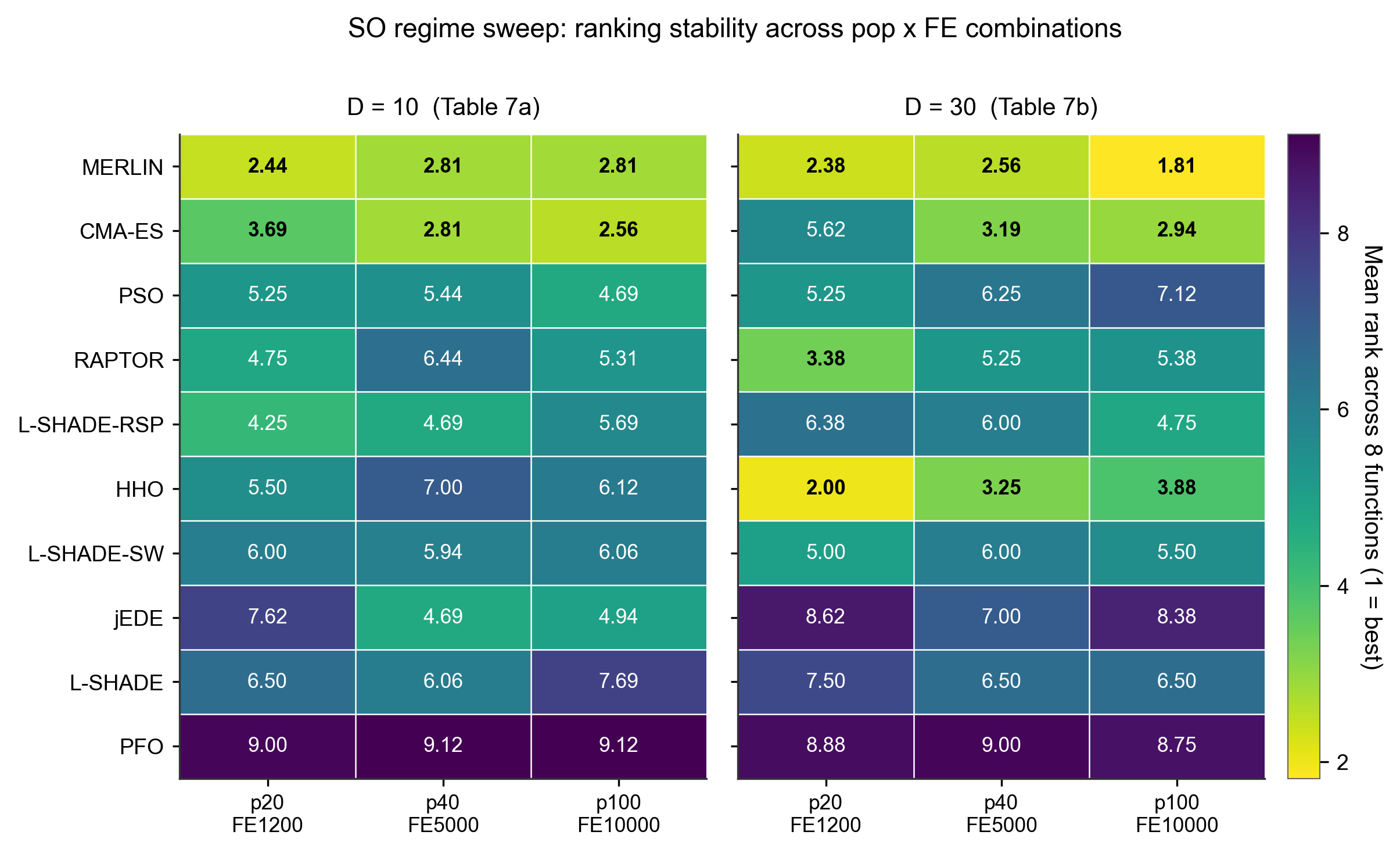
Pairwise tests on the canvas problems
Over 20 comparisons (TSP-10, TSP-15, TSP-20 and the shell, each against five external configurations; Mann–Whitney with Holm correction), CMA-ES wins 15 and MERLIN 13, and neither loses any. Galapagos is consistently among the weakest configurations on the canvas problems.
Finding 3: multi-objective hypervolume
Multi-objective performance was benchmarked across the full Zitzler-Deb-Thiele test suite (ZDT1–4 and ZDT6; 10,000 evaluations, 10 runs):
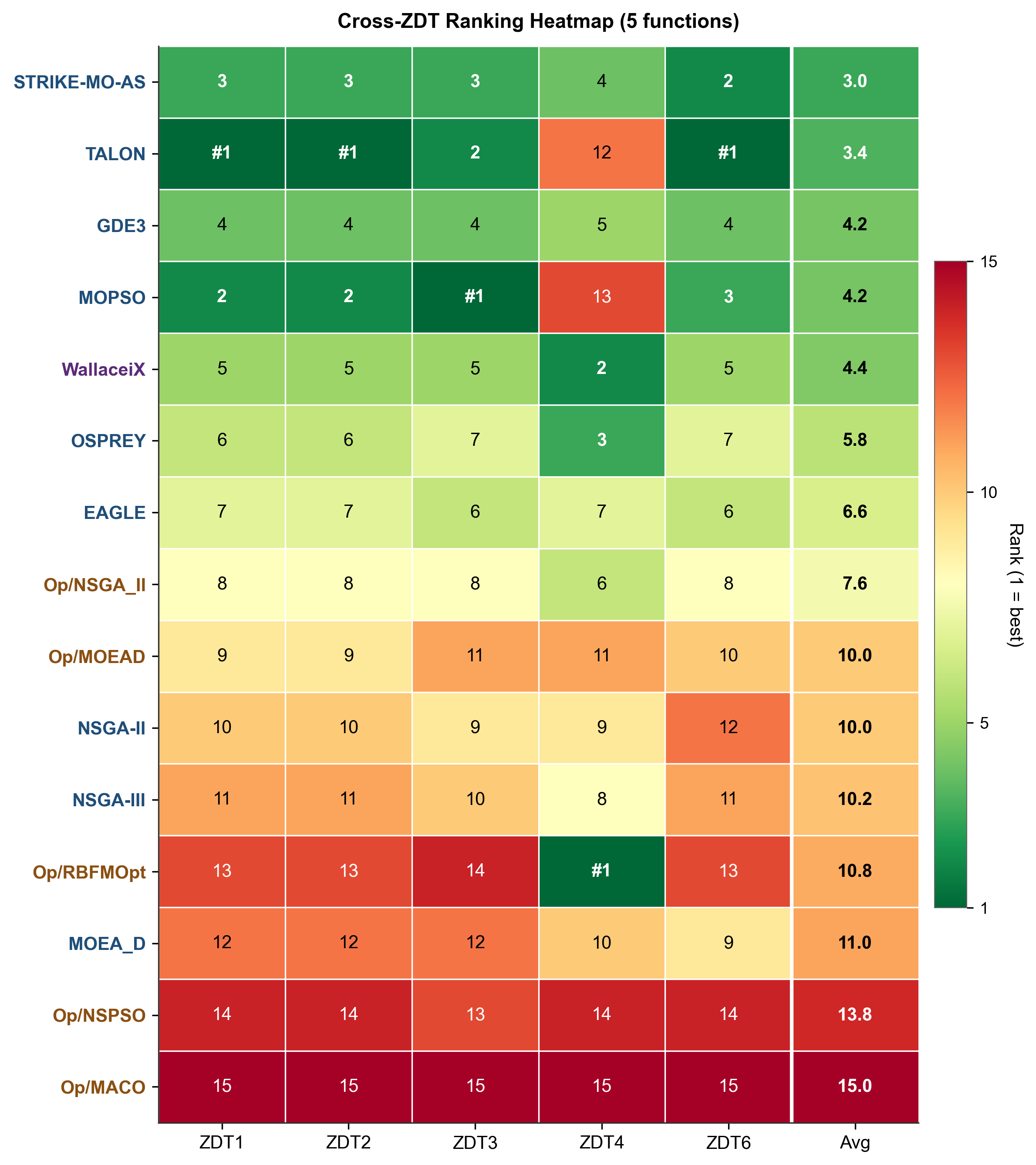
- No single winner. OSPREY and EAGLE rank 8th and 10th on ZDT, while they form the top tier on the building problem (ADO-D22): ranking depends on the problem class, which is why several multi-objective solvers are provided.
Case studies
Explore the dedicated benchmark documentation for the three flagship case studies:
- ADO-D22 (Daylight & Energy): 22 variables (18 continuous, 4 binary), evaluated by the Ambrosini GBR–ANN emulators (
). - Kakamigahara Free-Form Shell (D=85): Karamba3D structural finite element analysis median displacement 0.70 cm for MERLIN and CMA-ES (best run 0.50 cm), 48% below the best external configuration.
- Travelling Salesman (Held-Karp Ground Truth): Discrete sequencing on canvas with exact Held–Karp optima across 16 solvers.
References
- Ambrosini, L. (2026). SilverHawk Benchmark Report 2026: single- and multi-objective optimization in Grasshopper – the complete results of the 2026 benchmark campaigns. Zenodo Technical Report LA-SH-TR-2026-01, v1.0. doi:10.5281/zenodo.23768134
- Ambrosini, L. (2026). Hybrid metaheuristics for architectural design optimization under small evaluation and wall-clock budgets. arXiv:2610.26202 [cs.NE]. https://arxiv.org/abs/2610.26202
- Ambrosini, L. (2026). When the implementation matters more than the algorithm: NSGA-II and other multi-objective optimizers in engineering design tools. arXiv:2610.22397 [cs.NE]. https://arxiv.org/abs/2610.22397