
Roadmap: Native Surrogate Solver
SilverHawk currently provides metaheuristic and hybrid solvers. A native C# surrogate-based solver (radial basis functions) is in development, aimed at expensive simulations.
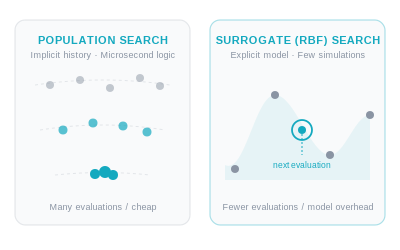
Figure 1: Conceptual difference between population swarm search and radial basis response surface interpolation.
Two Ways to Spend an Evaluation Budget
Every optimization solver must answer a fundamental question:
Given the evaluations completed so far, where should the next evaluation be spent?
| Methodology | Evaluation Strategy | Best Regime |
|---|---|---|
| Population-Based Search (PSO, GA, DE) | Relies on particle velocities, mutations, and crossovers. Discards individual point histories and focuses on current population states. | Fast simulations (milliseconds per call), large evaluation budgets ( |
| Surrogate-Assisted Search (RBF, Gaussian Processes) | Builds an interpolating mathematical response surface over all evaluated points. Solves an acquisition function to locate the next most informative design. | Expensive simulations (seconds to minutes per call), tight evaluation budgets ( |
Design goals
- No Python dependency: the solver runs inside Rhino without external environments.
- Aim: tight evaluation budgets on expensive models, where the Benchmark Report shows that surrogates can pay off (see Cross-comparison).
- Status: under development and validation; no release date or version is announced. Benchmark results will be published when available.