
Kakamigahara Free-Form Shell
The Kakamigahara Crematorium roof (Meiso no Mori, Japan, designed by Toyo Ito with structural engineering by Mutsuro Sasaki) has served as an iconic high-dimensional structural optimization benchmark in architectural computing since 2007.
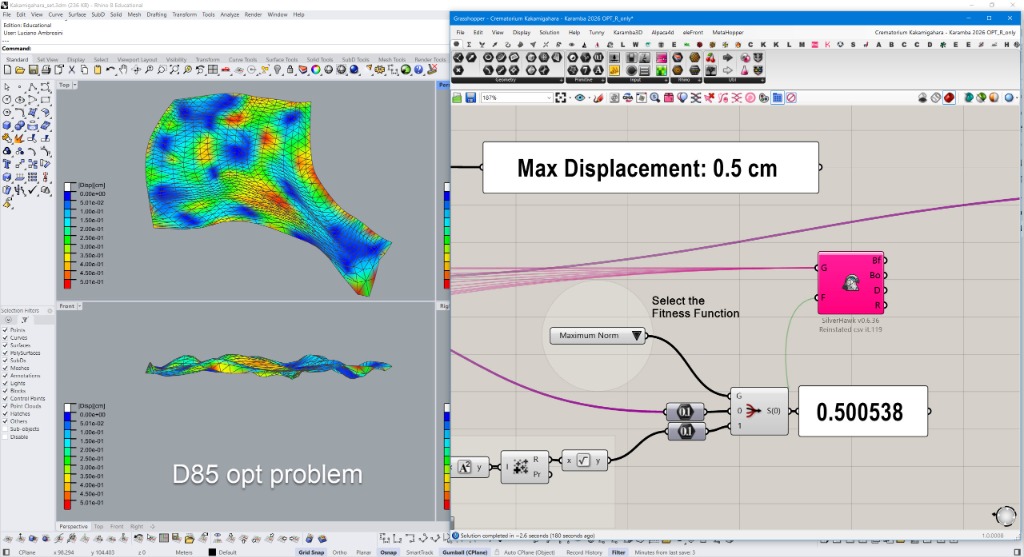
85-variable shell with a selectable fitness (maximum or Euclidean norm of the displacement). Requires Karamba3D (not included).
Problem Definition & Architectural Geometry
The roof consists of a continuous reinforced concrete shell spanning approximately
Problem Specifications
| Metric | Specification |
|---|---|
| Structure | Shell roof ( |
| Surface Geometry | Cubic NURBS surface controlled by a |
| Design Variables ( | Heights of 85 control points, each freely variable in |
| Structural Analysis | Linear elastic finite element analysis (FEA) in Karamba3D. One evaluation takes |
| Objective | Minimize maximum structural displacement (in cm) under self-weight dead load. A common structural target is |
Almost Two Decades of the Same Benchmark
Because neighboring control points govern the same surface patch, adjusting one point shifts the optimal position of all adjacent points—creating the curved valley of Rosenbrock in 85 dimensions. Initial random populations generate crumpled, wrinkly surfaces that require global coordination to resolve.
| Year | Researchers | Tools & Environment | Milestone Contribution |
|---|---|---|---|
| 2004 | Sasaki | Sensitivity analysis | Gradient-based form-finding for the real building, minimizing strain energy. |
| 2007 | Pugnale & Sassone | Structural morphogenesis (IASS 2007) | Free-form roof morphogenesis with coplanar elements. |
| 2013 | Pugnale | Grasshopper, Karamba, Galapagos | Reinterpretation in visual programming; became the Grasshopper community standard. |
| 2017 | Cichocka et al. | SilverEye (PSO) | Particle swarm benchmarked against Galapagos and Octopus; best published result: 0.60 cm in an 8-hour run. |
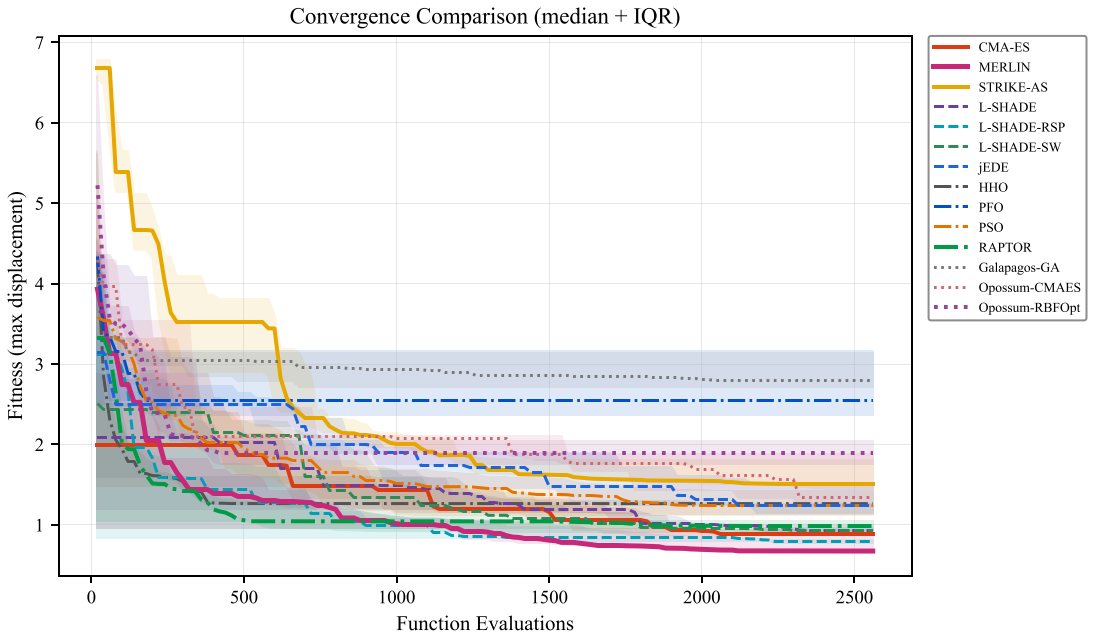
| 2026 | Ambrosini | Grasshopper, Karamba3D, SilverHawk | CMA-ES hybrid and population solvers tested under 15-minute budgets; MERLIN and CMA-ES reach a median of 0.70 cm (best single run 0.50 cm), 48% below the best external configuration (Opossum-CMA-ES, 1.34 cm median); Galapagos reaches 2.79 cm (Benchmark Report 2026; arXiv:2610.26202). |
Results under a 15-minute budget
In architectural practice, structural FEA models cannot afford tens of thousands of evaluations. the shell campaign gives every solver the same 15-minute wall-clock budget (about 1,955–2,457 evaluations per run, 5 runs per solver):
Takeaways
- Median vs. best run. MERLIN and CMA-ES reach a median of 0.696 and 0.697 cm over five runs; the best single run is 0.50 cm. The best external configuration (Opossum-CMA-ES) has a median of 1.34 cm, Galapagos 2.79 cm. The 48% figure compares medians.
- Context. SilverEye reached 0.60 cm in an 8-hour run (Cichocka et al., 2017); the figures above are obtained in 15 minutes, on a different machine and software stack, so treat the comparison as indicative.
- Why CMA-ES does well here is a hypothesis, not a tested result: its covariance adaptation can capture the strong coupling between neighboring control points.
- Surrogates. With about 0.4 s per evaluation the model fitting of surrogate solvers is not free (Opossum-RBFOpt: 1.75 s fitting per evaluation, 418 evaluations in 15 min). A native surrogate solver for SilverHawk is in development (see the Roadmap).
References
- Ambrosini, L. (2026). Hybrid metaheuristics for architectural design optimization under small evaluation and wall-clock budgets. arXiv:2610.26202 [cs.NE]. https://arxiv.org/abs/2610.26202
- Ambrosini, L. (2026). SilverHawk Benchmark Report 2026: single- and multi-objective optimization in Grasshopper – the complete results of the 2026 benchmark campaigns. Zenodo Technical Report LA-SH-TR-2026-01, v1.0. doi:10.5281/zenodo.23768134
- Cichocka, J. M., Browne, W. N., & Rodriguez, E. (2017). SilverEye – The Implementation of Particle Swarm Optimization Algorithm in a Design Optimization Tool. CAADRIA 2017, pp. 145–154. doi:10.52842/conf.caadria.2017.145
- Pugnale, A., & Sassone, M. (2007). Structural morphogenesis, with coplanar elements, of free-form roofs. In Proceedings of the IASS 2007 Symposium, Venice, Italy.