
Benchmark Components
SilverHawk includes three built-in benchmark components under panel 3. Benchmark. These components provide test problems wired directly to the solver, allowing algorithms, stopping criteria, and settings to be explored instantly without preparing an external analytical model.
All benchmark components take a vector of sliders x and return one or more objective values F plus an Info text summary. Their context menus include Create / Update Sliders (which instantiates sliders with exact problem bounds) and Remove Benchmark Setup (which cleans the canvas).
Benchmark Suite Summary
| Component | Problems Supported | Outputs |
|---|---|---|
| SH_BenchmarkSO | Classical single-objective functions with selectable dimensionality ( | F, Info |
| SH_BenchmarkMO | The standard ZDT multi-objective suite (ZDT1, ZDT2, ZDT3, ZDT4, ZDT6), two objectives. | F1, F2, Info |
| SH_BenchmarkADO | Architectural design optimization benchmark with 22 variables: single-objective modes ( | F1, F2, F3, Info |
SH_BenchmarkSO (Single-Objective Suite)
Provides classical analytical test functions widely recognized in mathematical optimization literature:
- Sphere Function: Unimodal, convex baseline.
- Booth Function: 2D quadratic test surface.
- Rosenbrock Function: Non-convex banana valley where finding the valley is easy, but tracking the minimum along the curve is challenging.
- Rastrigin Function: Highly multimodal with cosine modulation (severe local minima traps).
- Ackley Function: Flat outer domain with an exponential central funnel.
- Griewank Function: Many widespread local minima regularly distributed.
- Schwefel & Schwefel 1.2: Deceptive multimodal surfaces where optima lie near the domain boundaries.
- Step Function: Discontinuous plateaus testing gradient-free capabilities.
- Shifted (CEC-style): Offsets the global optimum away from the coordinate center
to prevent algorithms with coordinate origin bias from succeeding artificially.
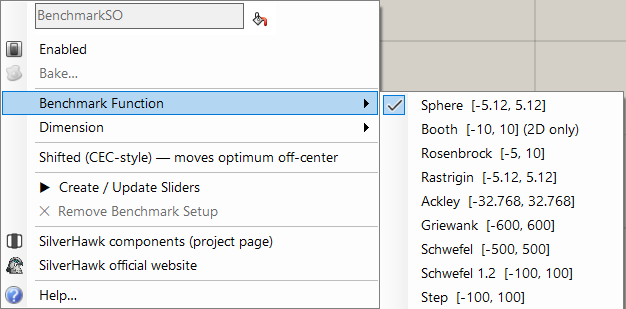
Single-objective test functions (centered and shifted forms) in one all-in-one component.
SH_BenchmarkMO (ZDT Multi-Objective Suite)
Implements the standard Zitzler-Deb-Thiele (ZDT) multi-objective benchmark suite:
- ZDT1: Convex Pareto-optimal front.
- ZDT2: Non-convex Pareto-optimal front testing preservation of lateral solutions.
- ZDT3: Disconnected Pareto front consisting of several discrete non-contiguous convex segments.
- ZDT4: Highly multimodal problem with
local Pareto-optimal fronts. - ZDT6: Non-uniform search space density with biased distribution along the front.
ZDT1–4 and ZDT6 as Grasshopper black boxes.
SH_BenchmarkADO (Architectural 22-Variable Benchmark)
The SH_BenchmarkADO component wraps surrogate models of a realistic architectural building performance problem with 22 decision variables (18 continuous, 4 binary) (Zorn et al. 2025, CC BY 4.0):
- Single-Objective Modes:
(Total annual energy demand, minimize) (Annual overheating degree-hours, minimize) (Daylight factor, maximize)
- Multi-Objective Modes:
(2 objectives) (2 objectives) (2 objectives) (3 objectives)
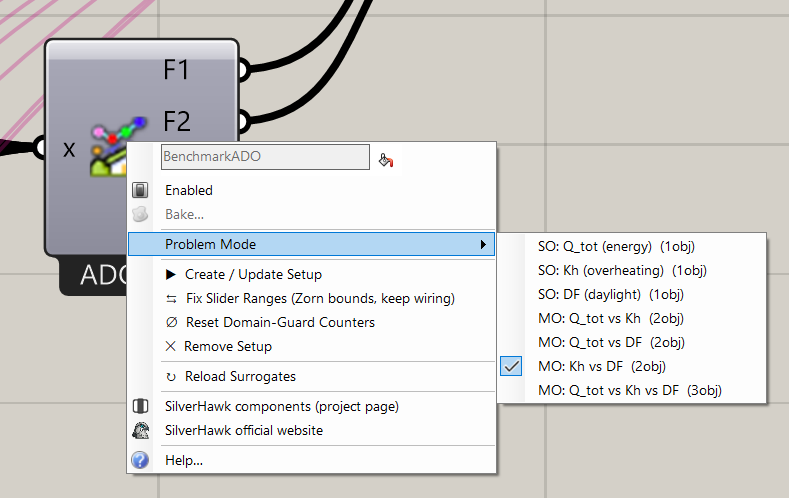
22 variables, evaluated by the GBR–ANN surrogate trained on the Zorn et al. (2025) dataset. Also the starting point for Examples A and B.